





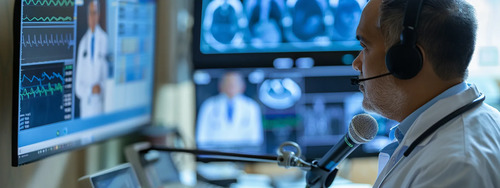
The healthcare landscape is continually evolving, driven by technological advancements. High-quality medical dictation software has emerged as a significant tool, transforming the way clinicians document patient care and communicate within medical facilities. This innovation not only streamlines workflows but also ensures accurate, readily accessible health records. Whether you’re a healthcare professional seeking to improve patient outcomes or an IT specialist looking for the next best step in medical tech, understanding the impact of medical dictation software is crucial. Keep reading to explore how this technology is shaping the future of healthcare.
Revolutionising Healthcare With Advanced Medical Dictation Software
Medical dictation software has become an indispensable tool for healthcare providers aiming to optimise their workflow. By converting speech to text, this technology enables doctors to document patient encounters in real time, which are then easily integrated into electronic health records (EHRs). Not only does this reduce documentation time, but it also allows practitioners to focus more on patient care rather than paperwork.
Advanced dictation solutions are designed with medical vocabulary in mind to ensure high accuracy. This means fewer errors and corrections, resulting in credible, consistent medical records. The cognitive load on healthcare providers is significantly reduced, allowing them to dictate notes naturally and intuitively without being bogged down by traditional typing.
Moreover, cloud-based dictation software enables access from virtually anywhere, at any time, adding convenience and flexibility to patient care. Doctors on the move can update patient records promptly, thereby enhancing the continuity of care. The result is a seamless flow of information within healthcare systems, making data-driven decisions more robust.
Embracing this technology also fosters collaboration among healthcare teams. Medical dictation software often integrates with other systems, enabling seamless information flow. This ensures that every member of the healthcare team, from nurses to specialists, has access to the most current patient information, minimising miscommunication and enhancing the overall quality of care.
Enhancing Accuracy and Efficiency in Patient Documentation
One of the primary benefits of medical dictation software is the remarkable improvement in documentation accuracy. Unlike manual transcription, which is prone to human error, dictation software is tailored to recognise medical terminology, significantly reducing the risk of errors. Consistently accurate documentation protects patient safety and the healthcare facility’s legal interests.
Additionally, the speed at which documentation can be completed with dictation software is unparalleled. Medical professionals can speak their observations and notes more quickly than typing. This swift process means that documentation no longer has to be a time-consuming afterthought at the end of a long shift.
In the quest for the best dictation software, healthcare facilities must consider tools that not only provide speed but also support a range of specialised vocabularies. Customisation options enable professionals to define custom terminology and phrases, further improving documentation accuracy and efficiency.
The cumulative effect of these improvements is less time spent on paperwork and more time available for patient interaction. Ultimately, this leads to a better patient experience, as healthcare providers can focus on the patient, knowing their administrative tasks are handled effectively.
Measuring the Impact of Medical Dictation Software on Healthcare Outcomes
The true value of medical dictation software becomes evident when analysing its impact on healthcare outcomes. With improved documentation accuracy and efficiency, medical errors can decrease, directly benefiting patient safety. The positive ripple effects of these metrics are evident across various aspects of healthcare delivery.
Quality dictation tools also contribute to increased job satisfaction among healthcare workers. By reducing the burden of cumbersome documentation, clinicians experience lower burnout and greater professional fulfilment. This improved morale can translate to better patient interactions and a more thriving workplace culture.
Metrics such as patient throughput and satisfaction scores indicate the efficiency gains enabled by medical dictation software. These tools enable faster patient turnover and higher-quality interactions by making records easy to update and accessible. Administratively, this translates into a more effective healthcare delivery system that maximises both resource utilisation and patient satisfaction.
The financial implications of dictation software cannot be overlooked. Reduced documentation time leads to cost savings for healthcare facilities. These resources can then be reallocated toward patient care initiatives or advanced medical technologies, thus perpetuating a cycle of improvement in healthcare services.
Integrating medical dictation software into healthcare practices delivers significant improvements in patient care, documentation efficiency, and data security. As AI continues to drive innovation in this field, the potential for improved healthcare outcomes becomes increasingly tangible. By embracing these technological developments, the medical community is well-positioned to deliver higher-quality care for generations to come.